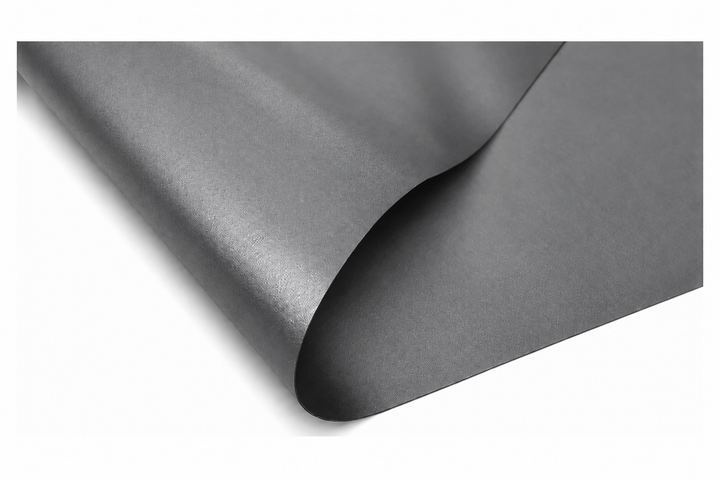
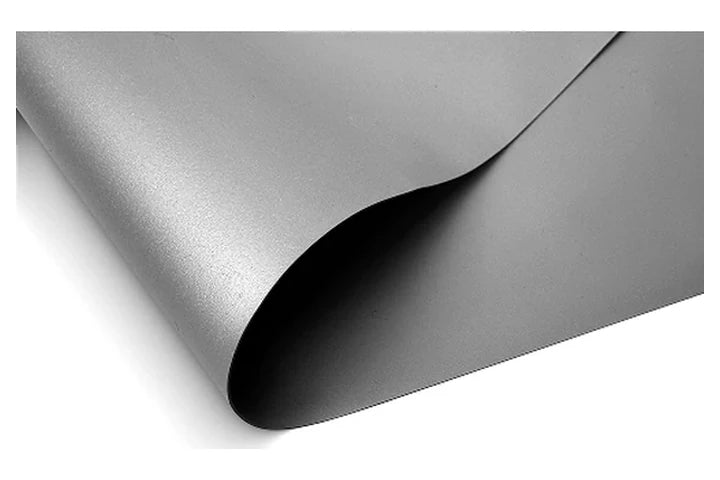
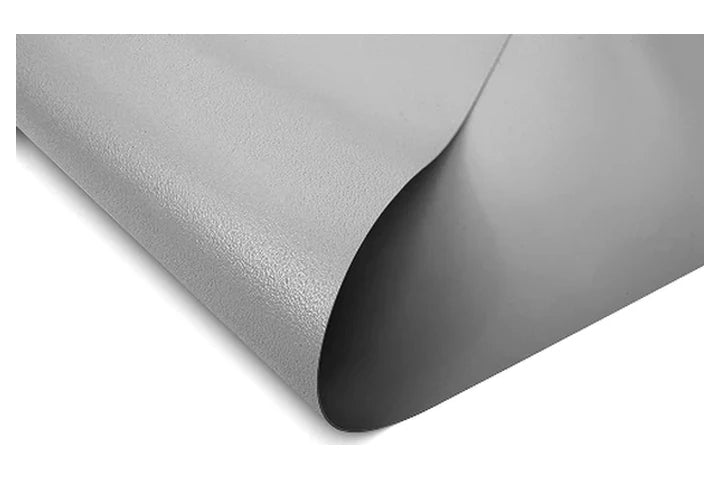
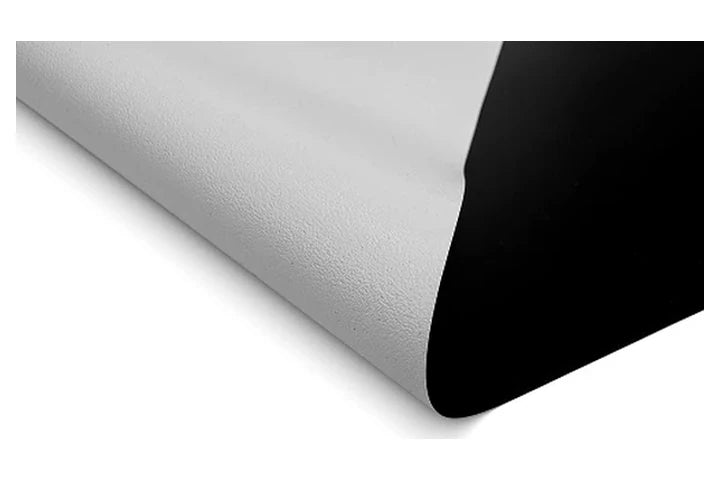
Horizontal image angle describes how wide the image looks from your seat. It is separate from a screen material’s viewing-angle specification. Distance guidance is a starting point; adjust to your preference.
Soft Grey Matte, Soft White Matte and Woven AT work with UST, short-, standard- and long-throw projectors. They are mainly used with standard / long throw; room-light control remains important.
USTCLR
CBSP
High contrast, deep blacks and excellent overhead light rejection, with wide viewing coverage for UST.
0.6 gain160° (nominal) · Wide viewing area
LimitationsFixed-frame sizes 130–150″ are seamed; control strong side/front light.
MATERIAL DETAILS · CLR
CBSP
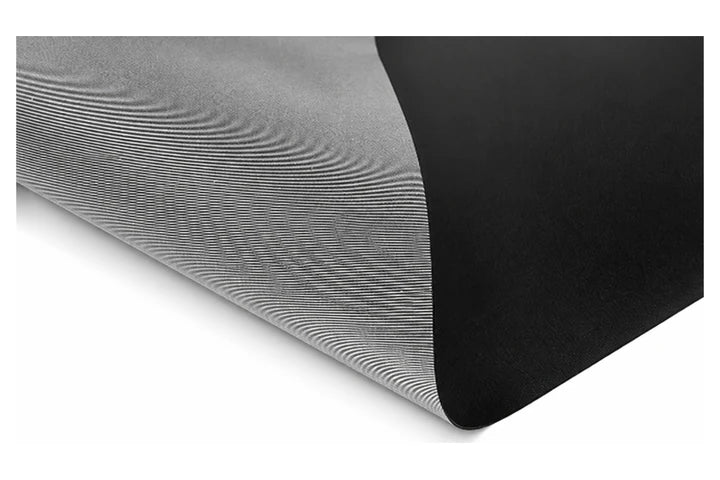
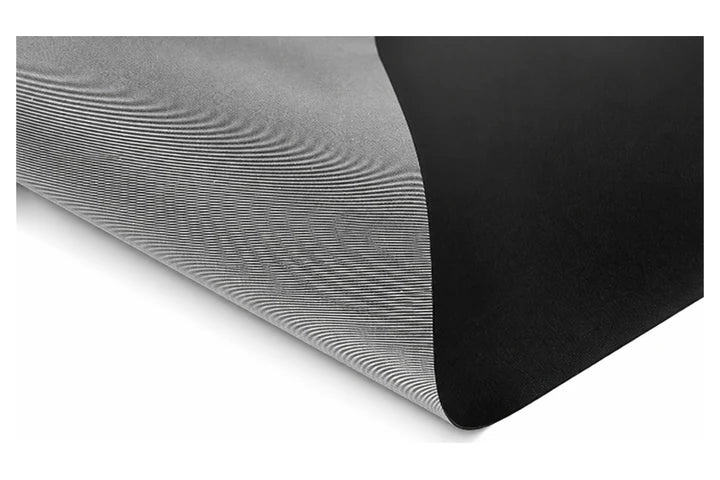
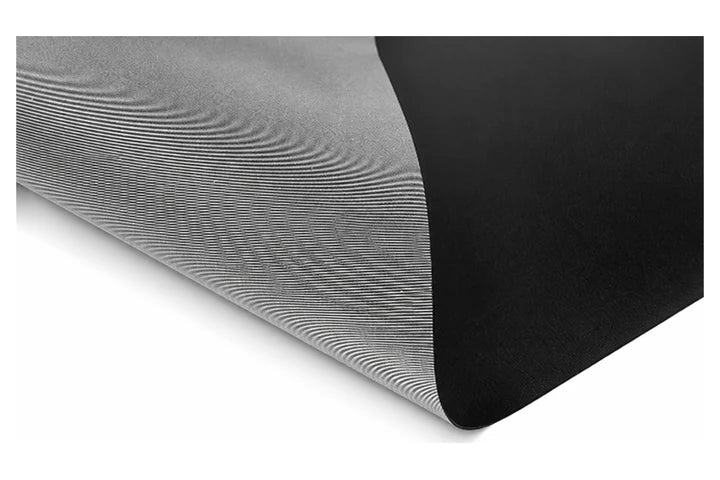
A black lenticular optical surface uses angled reflective faces to direct light from a UST projector toward the audience, while dark layers absorb light arriving from above.
Optics & image
Light rejection
CLR · Gallery: 94%; Gallery EVO UST2: 95%
Gain
0.6
Relative contrast
1.5 · Excellent
Nominal viewing angle
160°
Laser speckle
Low laser speckle
3D compatibility
3D ready
Resolution compatibility
4K / 8K UHD ready
Image-area acoustic transparency
No — image area. AT black-border options are model specific
Projector, room & installation
Recommended projector
UST, projected from below
Best environment
Living rooms with overhead ambient light
Seating
160° (nominal) · Wide viewing area
Available formats
Fixed frame, floor rising & drop down
Sizes & construction
Fixed frame: one-piece up to 127″; 130–150″ are seamed.
Brightness guidance
1,800+ ANSI lm · A starting point only; assess image size and room lighting
Limitations
Fixed-frame sizes 130–150″ are seamed; control strong side/front light.
Shop screens with this material
Available sizes and specifications depend on the screen model. Choose a series to explore its options.
Gain and light-rejection figures can vary by screen version. Check the selected model’s specifications. Brightness guidance is not a compatibility cutoff.
USTCLR
Lenticular UST
Wide-viewing CLR for large UST images, with overhead light rejection and seamless options up to 150″.
0.8 gain160° (nominal) · Wide viewing area
LimitationsControl strong side or frontal light. Sizes and seamless construction vary by model.
MATERIAL DETAILS · CLR
Lenticular UST
A sawtooth lenticular surface reflects light from below toward the seating area while its dark optical layers absorb overhead light. One-piece construction is available on the specified large-screen models.
Optics & image
Light rejection
CLR · ≥90% on the 150″ Gallery EVO fixed-frame model
Gain
0.8
Relative contrast
1.3 · Good
Nominal viewing angle
160°
Laser speckle
Low laser speckle
3D compatibility
3D ready
Resolution compatibility
4K / 8K UHD ready
Image-area acoustic transparency
No — image area. AT black-border options are model specific
Projector, room & installation
Recommended projector
UST, projected from below
Best environment
Living rooms or controlled lighting
Seating
160° (nominal) · Wide viewing area
Available formats
Fixed frame, floor rising & drop down
Sizes & construction
Seamless options up to 150″; check the screen model and size
Brightness guidance
1,700+ ANSI lm · A starting point only; assess image size and room lighting
Contrast priority
Consider CBSP if its size and screen format meet your needs
Limitations
Control strong side or frontal light. Sizes and seamless construction vary by model.
Shop screens with this material
Available sizes and specifications depend on the screen model. Choose a series to explore its options.
Gain and light-rejection figures can vary by screen version. Check the selected model’s specifications. Brightness guidance is not a compatibility cutoff.
USTALR
Fresnel UST
Extremely high contrast and WUPRO’s best UST light rejection, ideal for bright rooms and central seating.
1.25–1.6 gainOptimal viewing angle: 90°
LimitationsBrightest near the centre; dims toward wide seats.
MATERIAL DETAILS · ALR
Fresnel UST
Concentric Fresnel optical structures redirect UST projector light toward the audience and suppress unwanted light from above and the sides.
Optics & image
Light rejection
ALR · ≥85%
Gain
1.25–1.6
Model examples
100″: 1.6 · 120″: 1.25 · separate 150″ model: 1.25–1.5
Relative contrast
1.7 · Outstanding
Nominal viewing angle
160°
Optimal viewing angle
90°
Laser speckle
Projector dependent
3D compatibility
3D ready
Resolution compatibility
4K / 8K UHD ready
Image-area acoustic transparency
No — image area
Projector, room & installation
Recommended projector
UST, projected from below
Best environment
Bright rooms with side or mixed ambient light
Seating
Central seating recommended
Available formats
Fixed frame available now; motorized versions coming soon.
Sizes & construction
Peacock / Peacock EVO fixed frame; separate 150″ seamless model
Brightness guidance
1,600+ ANSI lm · A starting point only; assess image size and room lighting
Limitations
Brightest near the centre; dims toward wide seats.
Shop screens with this material
Available sizes and specifications depend on the screen model. Choose a series to explore its options.
Gain and light-rejection figures can vary by screen version. Check the selected model’s specifications. Brightness guidance is not a compatibility cutoff.
USTCLR
BSP / KBSP
Value-focused UST CLR options with effective overhead light rejection and a wide viewing area.
0.7 gain160° (nominal) · Wide viewing area
LimitationsAvoid strong light directly on the screen. Fixed frame only; up to 133″.
MATERIAL DETAILS · CLR
BSP / KBSP
BSP and KBSP use black lenticular optical surfaces to direct UST light toward the audience and absorb overhead light. Available as fixed-frame screens, with sizes up to 133″ across the range.
Optics & image
Light rejection
CLR · 90–93%
Gain
0.7
Relative contrast
1.3 · Good
Nominal viewing angle
160°
Laser speckle
Low laser speckle
3D compatibility
3D ready
Resolution compatibility
4K / 8K UHD ready
Image-area acoustic transparency
No — image area
Optical construction
PET-based lenticular surface with a TPU optical layer
Projector, room & installation
Recommended projector
UST, projected from below
Best environment
Living rooms with overhead ambient light
Seating
160° (nominal) · Wide viewing area
Available formats
Fixed frame only · Up to 133″
Sizes & construction
Up to 133″ across the range; KBSP offers a one-piece 132″.
Brightness guidance
A starting point only; assess image size and room lighting
Limitations
Avoid strong light directly on the screen. Fixed frame only; up to 133″.
Shop screens with this material
Available sizes and specifications depend on the screen model. Choose a series to explore its options.
Up to 133″ across the range; KBSP offers a one-piece 132″.
Gain and light-rejection figures can vary by screen version. Check the selected model’s specifications. Brightness guidance is not a compatibility cutoff.
STANDARD / LONG THROWCLR
LT Lenticular
WUPRO’s best standard / long-throw image: deep blacks, exceptional contrast, strong light rejection and low speckle.
1.0 gain170° (nominal) · Wide viewing area
LimitationsFixed frame only. Designed for standard / long throw, not UST.
MATERIAL DETAILS · CLR
LT Lenticular
A specialized lenticular optical structure controls unwanted light while preserving image contrast and reducing visible laser speckle, including with RGB triple-laser projectors.
Optics & image
Light rejection
CLR · 94%
Gain
1.0
Contrast performance
WUPRO’s best standard / long-throw contrast and blacks
Nominal viewing angle
170°
Laser speckle
Low laser speckle
3D compatibility
3D ready
Resolution compatibility
4K / 8K UHD ready
Image-area acoustic transparency
No — image area
Projector, room & installation
Recommended projector
Standard / long throw · Supports any projection angle within standard / long-throw setups
Best environment
Bright, moderately lit or controlled-light home cinema
Seating
170° (nominal) · Wide viewing area
Available formats
Fixed frame only
Sizes & construction
16:9 up to 130″; wider CinemaScope formats up to 160″
Brightness guidance
2,000+ lm · A starting point only; assess image size and room lighting
Projection angle
Supports any projection angle within standard / long-throw setups
Distance guidance
At least 1.5× screen width is advised for uniformity, not a compatibility cutoff
Limitations
Fixed frame only. Designed for standard / long throw, not UST.
Shop screens with this material
Available sizes and specifications depend on the screen model. Choose a series to explore its options.
16:9 up to 130″; wider CinemaScope formats up to 160″
Gain and light-rejection figures can vary by screen version. Check the selected model’s specifications. Brightness guidance is not a compatibility cutoff.
STANDARD / LONG THROWALR
Black Crystal
Deep blacks, excellent contrast and strong ambient light rejection for standard / long-throw projectors.
LimitationsRGB laser projectors can produce pronounced speckle. Test a sample if sensitive.
MATERIAL DETAILS · ALR
Black Crystal
A dark, multilayer optical surface is designed to improve perceived contrast and reject unwanted ambient light while preserving a detailed projected image.
Optics & image
Light rejection
ALR ≥70%
Gain
0.8
Contrast performance
Excellent contrast and deeper blacks
Nominal viewing angle
160°
Laser speckle
Pronounced speckle with RGB laser
3D compatibility
3D ready
Resolution compatibility
4K / 8K UHD ready
Image-area acoustic transparency
No — image area
Projector, room & installation
Recommended projector
Standard / long throw
Best environment
Living rooms or controlled lighting
Seating
160° (nominal) · Check off-axis brightness
Available formats
Fixed frame, floor rising & drop down
Sizes & construction
Sizes and construction depend on the selected screen series
Brightness guidance
A starting point only; assess image size and room lighting
Limitations
RGB laser projectors can produce pronounced speckle. Test a sample if sensitive.
Shop screens with this material
Material is preselected on the LeApex and FlowArc product pages. Choose your size and finish there.
Gain and light-rejection figures can vary by screen version. Check the selected model’s specifications. Brightness guidance is not a compatibility cutoff.
STANDARD / LONG THROWHigh gain
Grey Crystal
High brightness, crisp detail and enhanced 3D performance for standard / long-throw projection.
1.2 gain160° (nominal) · Wide viewing area
LimitationsRGB laser projectors can produce pronounced speckle. Test a sample if sensitive.
MATERIAL DETAILS · High gain
Grey Crystal
A high-gain optical surface delivers bright images, crisp detail for high-resolution projection and strong 3D presentation, with a degree of ambient-light resistance. LT Lenticular and Black Crystal provide stronger light rejection.
Optics & image
Light rejection
A degree of ambient-light resistance
Gain
1.2
Contrast performance
High-gain brightness, crisp detail and strong 3D presentation
Nominal viewing angle
160°
Laser speckle
Pronounced speckle with RGB laser
3D compatibility
Enhanced 3D presentation; confirm the projector’s 3D system
Resolution compatibility
4K / 8K UHD ready
Image-area acoustic transparency
No — image area
Projector, room & installation
Recommended projector
Standard / long throw
Best environment
Rooms with some ambient light; assess its direction and intensity
Seating
160° (nominal) · Wide viewing area
Available formats
Fixed frame, floor rising & drop down
Sizes & construction
Sizes and construction depend on the selected screen series
Brightness guidance
A starting point only; assess image size and room lighting
Limitations
RGB laser projectors can produce pronounced speckle. Test a sample if sensitive.
Shop screens with this material
Material is preselected on the LeApex and FlowArc product pages. Choose your size and finish there.
Gain and light-rejection figures can vary by screen version. Check the selected model’s specifications. Brightness guidance is not a compatibility cutoff.
UNIVERSALNon-ALR
Soft Grey Matte
The best balance of lower laser speckle, deeper blacks and tolerance of a little ambient light.
0.9 gain160° (nominal) · Wide viewing area
LimitationsNot a dedicated ALR / CLR material. Keep ambient light low and controlled.
MATERIAL DETAILS · Non-ALR
Soft Grey Matte
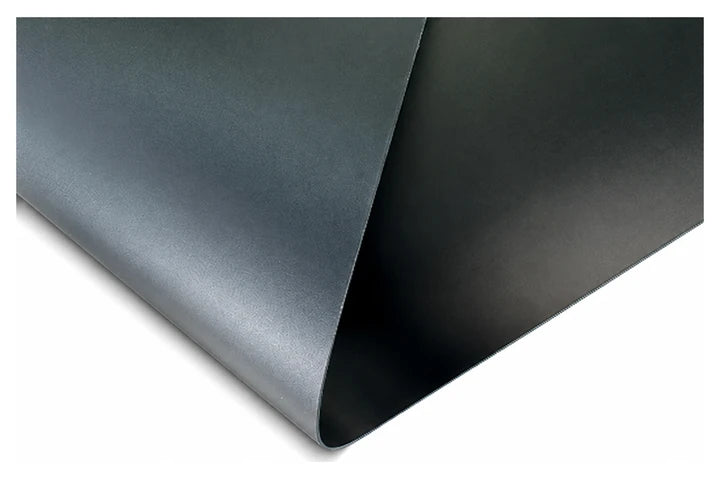
A soft grey optical coating on a flexible screen surface produces diffuse reflection, helping deepen perceived blacks while keeping visible laser speckle low.
Optics & image
Light rejection
Non-ALR / non-CLR
Gain
0.9
Contrast performance
Deeper blacks and higher contrast than Soft White Matte
Nominal viewing angle
160°
Laser speckle
Low laser speckle
3D compatibility
Active 3D ready; confirm the projector’s 3D system
Resolution compatibility
4K / 8K UHD ready
Image-area acoustic transparency
No — image area
Projector, room & installation
Recommended projector
UST, short, standard & long throw · Mainly standard / long throw
Best environment
Dark rooms or low, controlled ambient light
Seating
160° (nominal) · Wide viewing area
Available formats
Fixed frame, floor rising & drop down
Sizes & construction
Sizes and construction depend on the selected screen series
Brightness guidance
A starting point only; assess image size and room lighting
Typical use
Mainly standard / long throw
UST setup
Use a flat, evenly tensioned surface and accurate projector positioning
Limitations
Not a dedicated ALR / CLR material. Keep ambient light low and controlled.
Shop screens with this material
Material is preselected on the LeApex and FlowArc product pages. Choose your size and finish there.
Gain and light-rejection figures can vary by screen version. Check the selected model’s specifications. Brightness guidance is not a compatibility cutoff.
UNIVERSALNon-ALR
Soft White Matte
Higher brightness than Soft Grey Matte, with low speckle and wide viewing coverage. Dark rooms only.
1.0 gain160° (nominal) · Wide viewing area
LimitationsDark room only; ambient light and room reflections reduce contrast.
MATERIAL DETAILS · Non-ALR
Soft White Matte
A matte white optical coating diffuses projected light broadly, producing a bright image with low visible speckle. For dark rooms only.
Optics & image
Light rejection
Non-ALR / non-CLR
Gain
1.0
Contrast performance
Lighter blacks and lower contrast than Soft Grey Matte
Nominal viewing angle
160°
Laser speckle
Low laser speckle
3D compatibility
Active 3D ready; confirm the projector’s 3D system
Resolution compatibility
4K / 8K UHD ready
Image-area acoustic transparency
No — image area
Projector, room & installation
Recommended projector
UST, short, standard & long throw · Mainly standard / long throw
Best environment
Fully dark room only
Seating
160° (nominal) · Wide viewing area
Available formats
Fixed frame, floor rising & drop down
Sizes & construction
Sizes and construction depend on the selected screen series
Brightness guidance
A starting point only; assess image size and room lighting
Typical use
Mainly standard / long throw
UST setup
Use a flat, evenly tensioned surface and accurate projector positioning
Limitations
Dark room only; ambient light and room reflections reduce contrast.
Shop screens with this material
Material is preselected on the LeApex and FlowArc product pages. Choose your size and finish there.
Gain and light-rejection figures can vary by screen version. Check the selected model’s specifications. Brightness guidance is not a compatibility cutoff.
UNIVERSALNon-ALR
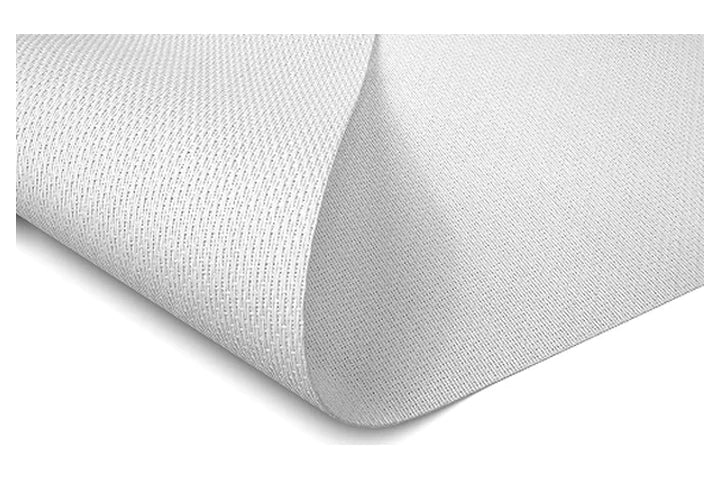
Woven AT
WUPRO’s best speckle suppression, near-zero visible speckle and acoustic transparency for speakers behind the image.
1.0 gain160° (nominal) · Wide viewing area
LimitationsWeave may show up close. No ambient light rejection; controlled lighting required.
MATERIAL DETAILS · Non-ALR
Woven AT
A fine woven projection surface allows sound to pass through the image area. Its textile structure helps minimize visible laser speckle while supporting speaker placement behind the screen.
Optics & image
Light rejection
Non-ALR / non-CLR
Gain
1.0
Contrast performance
Neutral; controlled light required
Nominal viewing angle
160°
Laser speckle
Lowest; near-zero visible speckle
3D compatibility
Confirm for the selected screen model and projector
Resolution compatibility
4K UHD confirmed; confirm 8K for the selected model
Image-area acoustic transparency
Yes — full projected image area
Projector, room & installation
Recommended projector
UST, short, standard & long throw · Mainly standard / long throw
Best environment
Dark or well-controlled home cinema
Seating
160° (nominal) · Wide viewing area
Available formats
Fixed frame & motorized drop down
Sizes & construction
Sizes and construction depend on the selected screen series
Brightness guidance
A starting point only; assess image size and room lighting
Typical use
Mainly standard / long throw
UST setup
Use a flat, evenly tensioned surface and accurate projector positioning
Black backing
Gallery G3A: optional black backing. FlowArc: no backing by default
Viewing distance
Fine weave may be visible up close; test a sample from your seat
Limitations
Weave may show up close. No ambient light rejection; controlled lighting required.
Shop screens with this material
Available sizes and specifications depend on the screen model. Choose a series to explore its options.
Gain and light-rejection figures can vary by screen version. Check the selected model’s specifications. Brightness guidance is not a compatibility cutoff.
i
Using a short-throw projector in a dark room? You can also explore .
SIDE BY SIDECompare what mattersChoose up to three materials. See the useful differences at a glance.
0 / 3 selected
Select two or three materials to compare.
Material characteristics are a starting point. Use the finder above to check size, installation and seating requirements together. ALR / CLR rates are model-specific; light direction and test conditions affect comparisons. Value comparisons assume the same size, installation format and market.
SEE IT IN YOUR OWN ROOM
See the difference with your own projector.
Compare contrast, brightness, texture and visible laser speckle in your own room before choosing a full-size screen.
Sample fee refundable when you later buy a full-size projector screen at wuprobuy.com. See sample pack terms. A4 samples cannot fully represent full-screen uniformity or viewing range.
A LITTLE MORE CLARITY
Questions before you choose?
Simple answers to the details that can change your decision.
How can I get the A4 sample cost refunded?+
After you order a full-size projector screen at wuprobuy.com, the refund process depends on where you purchased your A4 sample pack:
Purchased at wuprobuy.com: Your sample pack fee will be automatically refunded within 3 business days of your screen order. No action is required on your part.
Purchased through another WUPRO sales channel: Please contact us with your A4 sample pack purchase details, such as the sales platform and order number. We’ll verify your purchase and arrange the refund.
Is Fresnel better than Lenticular UST?+
Neither is universally better. Fresnel generally offers higher gain and stronger rejection of ambient light from multiple directions. It works especially well in bright rooms with central seating, but its optimal viewing area is narrower.
Lenticular UST generally provides a wider, more even viewing area. It is often a better fit for broad seating layouts and many motorized screen designs. Motorized Fresnel designs are also possible.
Which material reduces laser speckle the most?+
Woven AT provides WUPRO’s strongest speckle suppression, with little to nearly no visible speckle. It also allows speakers behind the image, but has no ALR and its weave may be visible up close.
For standard / long throw, Lenticular LT combines low speckle with excellent contrast and light rejection. Soft Grey Matte is the balanced choice for low speckle, deeper blacks and a little ambient light. Soft White Matte, CBSP, Lenticular UST and BSP / KBSP also have low speckle.
Fresnel depends on the projector. Black Crystal and Grey Crystal can show pronounced speckle with RGB laser projectors. Test the intended material with your own projector; no material guarantees zero speckle in every setup.
Why is the viewing angle of the Fresnel ALR screen listed as 160° if its optimal viewing angle is narrower?+
The 160° specification is the rated overall viewing angle, not a promise of consistent brightness or image quality throughout that range. WUPRO lists an optimal viewing angle of 90° for this Fresnel material.
Its directional optical structure reflects more projected light toward the central viewing area, enhancing brightness, contrast and ambient light rejection. Brightness gradually decreases as viewers move farther to the sides, so the optimal viewing area is narrower than the overall range.
The half-gain angle is a separate measurement: the off-center angle where brightness drops to 50% of its peak. It is not the overall viewing angle or the optimal viewing range; the 90° optimal rating should not be read as a half-gain specification.
For the best image, choose central seating. For wider seating or multiple viewers, a Lenticular CLR screen generally provides more consistent brightness across a broader area.
Does screen gain affect laser speckle?+
Yes, but gain is only one factor. With some RGB laser projectors, higher-gain or more directional screens can make speckle more noticeable, while lower-gain or more diffusive materials may reduce it.
Surface structure and coatings can matter just as much as gain. Do not judge speckle performance by gain alone; compare the actual material and projector combination.
Can a Fresnel projector screen be motorized?+
Yes. Fresnel screens can be engineered as motorized floor-rising or drop-down screens.
WUPRO expects to launch a motorized floor-rising Fresnel screen in late October 2026, with ordering planned through wuprobuy.com after launch. This is a planned release, not confirmation of current availability; timing may change.
The precision optical structure requires more advanced tensioning, flatness control and rolling mechanisms than conventional materials. A properly engineered design can combine effective ambient light rejection with retractable convenience.
Can I use a matte screen with a UST projector?+
Yes. Soft Grey Matte, Soft White Matte and Woven AT are universal options compatible with UST, short-, standard- and long-throw projection, though they are mainly used with standard / long throw.
For UST, a flat, evenly tensioned surface and accurate positioning are especially important. Control room light and check image uniformity, visible texture and speckle with your own projector. These materials are not substitutes for dedicated UST light-rejecting optics in a bright room.
What is the difference between ALR and CLR?+
ALR means ambient light rejecting. CLR emphasizes ceiling light rejection. Neither label means that all light from every direction is removed, or that a material works with every projector.
In this guide, Fresnel UST and Black Crystal are labeled ALR; CBSP, Lenticular UST, BSP / KBSP and Lenticular LT are labeled CLR. Grey Crystal is not ALR. Choose by the material’s actual optical design, projector compatibility and room lighting—not by the acronym alone.